




Call to Expand Private Sector Partnerships Amid Challenges of AI, Labor Mobility, and Climate Change
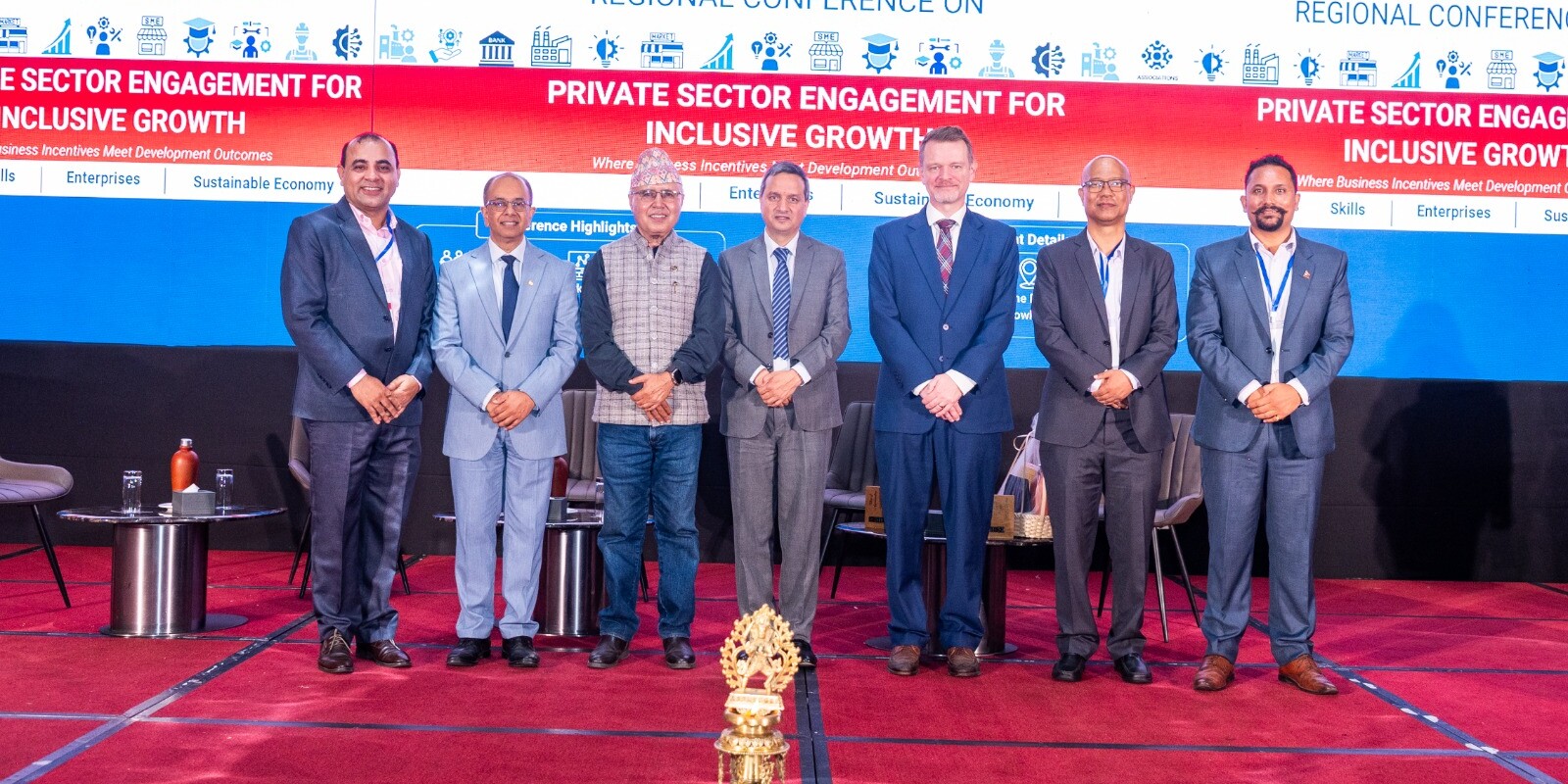
The question is no longer whether the private sector should be involved in development, but rather how this engagement can be institutionalized, adapted, and scaled up in a world rapidly changing due to artificial intelligence (AI), rising labor mobility, and climate change. This was the core message from the regional conference "Private Sector Engagement for Inclusive Development" held in Kathmandu. Jointly organized by the Confederation of Nepalese Industries (CNI) and Helvetas Nepal under the theme "Converging Business Incentives and Development Outcomes," the event brought together around 150 policymakers, business leaders, development practitioners, financial institution representatives, academics, and entrepreneurs from Nepal and across the region. Participants discussed best practices for involving the private sector in skill development, entrepreneurship promotion, and sustainable economic development, while exploring how to adapt and expand these practices to meet emerging challenges. The discussions focused on how businesses, governments, and development partners can work together to create both commercial value and positive social impact, ultimately building a more resilient and inclusive economy.
The chief guest of the event, National Planning Commission Vice-Chairman Hon’ble Dr. Gunakar Bhatta, reaffirmed the government’s commitment to creating an enabling environment for investment, innovation, entrepreneurship, and private sector-led economic growth. Emphasizing that the business community needs to play a more active role in the nation's development journey, he noted that the public sector alone cannot be the sole engine of economic growth. Highlighting the limitations of state fiscal resources and operational flexibility, he stated that the path to inclusive growth must be built through a dynamic private sector, encouraging enterprises to connect marginalized regions, small businesses, and underutilized labor forces with regional and global value chains.
Delivering a special address, former Finance Minister Rameshwar Khanal highlighted the central role of the private sector in productivity, innovation, investment, and job creation in Nepal. Stressing the need to build a more favorable business climate, he said that if Nepal wants to achieve its ambitions regarding investment, exports, energy development, and job creation, the government must act as a facilitator rather than a regulator, creating an environment where businesses can invest with confidence.
CNI President Birendra Raj Pandey emphasized the importance of collaborative efforts to tackle employment challenges and strengthen Nepal’s economic competitiveness. Noting that a stronger partnership among key stakeholders is vital, he remarked that the future demands a new development compact, which must be built on trust, collaboration, and shared responsibility among government, businesses, workers, development partners, and communities.
Providing a regional perspective, Dr. Juerg Merz, Helvetas Asia Regional Coordinator, shared experiences from various Asian countries, stating that private sector engagement is not just about mobilizing extra resources, but about building structured partnerships that create shared value. He observed that development cooperation is gradually shifting from traditional grant-based models to technical assistance models that use co-financing, blended finance, and private investment to create systemic impact. This shift highlights the growing importance of strategic business partnerships in delivering robust development outcomes and building resilient economies. Mathias Meyer, Deputy Head of the Swiss Development Cooperation (SDC), spoke about Switzerland’s long-term commitment to market-led development and economic inclusion, adding that the private sector is indispensable for sustainable development. He noted that meaningful partnerships are not just convenient arrangements, but relationships where costs, risks, and responsibilities are shared.
Representatives from Nepal, Myanmar, Bangladesh, and Vietnam exchanged their experiences across three thematic sessions focusing on skill development, entrepreneurship promotion, and sustainable economic development, discussing best practices, challenges, and opportunities. A common message echoed throughout the conference was that the private sector should not be seen merely as a beneficiary of development interventions, but as a strategic partner capable of co-investing, driving innovation, and contributing to long-term development outcomes.
Manish Pradhan, Country Director of Helvetas Nepal, stressed the need to build strong partnerships capable of turning dialogue into meaningful action. He explained that effective private sector engagement is a matter of relationship rather than transaction relationships that align incentives, share risks, and build trust over time. From a development standpoint, this means clarifying roles and helping market systems operate more effectively and inclusively. The conference concluded with a shared commitment to strengthen collaboration, scale up successful partnership models, and promote private sector-led solutions that contribute to decent employment, entrepreneurship, sustainability, and inclusive economic growth in Nepal and the wider region.
As an integral part of the conference, a skills competition was organized for trainees across Bagmati Province in collaboration with the Confederation of Bagmati Province Industries (CBPI) under the theme "Private Sector Engagement: Branding TVET." Young trainees from the IT, automobile, and hospitality sectors demonstrated their technical skills, creativity, and workplace competencies. Following evaluations by industry experts, Sushma Tamang won in the IT category, Prem Gole in the automobile category, and Sudip Waiba in the hospitality category. Additionally, Amrita Praja received the CBPI Presidential Award 2026 for securing the highest marks in the trainee examination, while Softy Hygiene Pvt. Ltd. was honored with an appreciation certificate, which was received by its Managing Director, Yadav Ghimire.
The conference also featured a digital services and products marketplace, offering a practical demonstration of how digital innovation is transforming skill development, employment, entrepreneurship, foreign employment management, and enterprise development. The marketplace showcased innovative solutions developed and promoted by GLocal, Helvetas Bangladesh, Helvetas Vietnam, Rupandehi Industries Association (RCI), CNI, the ReMI project, and the Buddha Incubation Center. The display sent a clear message that digital transformation is not an end in itself, but a means to create practical, data-driven solutions that bridge the gap between information and action, people and opportunities, and ideas and impact, ultimately contributing to a more inclusive, resilient, and sustainable economic development.